 (+86)0755-21023851
 gque@quixave.com
Abstract: Resin microspheres are widely applied in biomedicine, composite materials, drug delivery and industrial coating fields due to their uniform particle size, stable chemical properties and excellent surface modifiability. Encapsulation treatment is a core process to optimize the surface performance, mechanical strength and environmental adaptability of resin microspheres. As a low-shear, high-uniformity mixing device, roller mixers have gradually become key specialized equipment for resin microsphere encapsulation, replacing traditional high-shear stirring equipment. This paper systematically elaborates the working principle of roller mixers, analyzes their unique advantages in microsphere suspension stabilization, uniform coating formation, particle structure protection and defect reduction, and discusses their practical application value and process optimization strategies in resin microsphere encapsulation, aiming to provide technical reference for high-quality and high-yield microsphere encapsulation production.
1. Introduction
Resin microsphere encapsulation refers to the technical process of covering a layer of functional polymer, inorganic coating or composite film on the surface of resin microspheres through liquid-phase reaction, surface grafting or physical coating. The quality of encapsulation directly determines the performance of microsphere products: uniform and complete coating can significantly improve the wear resistance, corrosion resistance and biocompatibility of microspheres, while uneven coating, particle breakage or bubble defects will seriously restrict the application effect of microspheres.
In traditional encapsulation processes, high-speed mechanical stirrers, homogenizers and other equipment are commonly used to mix microsphere suspensions and coating materials. However, such equipment generates strong shear force during operation, which easily causes microsphere fragmentation, coating peeling and particle agglomeration. In addition, high-speed stirring will introduce a large number of tiny bubbles into the reaction system, forming pore defects on the microsphere coating surface and reducing the compactness of the encapsulation layer. Different from traditional stirring equipment, roller mixers realize material mixing through the overall low-speed rolling of the container, featuring low shear, low bubble generation and stable suspension, which perfectly matches the technical requirements of resin microsphere encapsulation and solves many bottleneck problems in traditional processes.
2. Working Principle of Roller Mixers
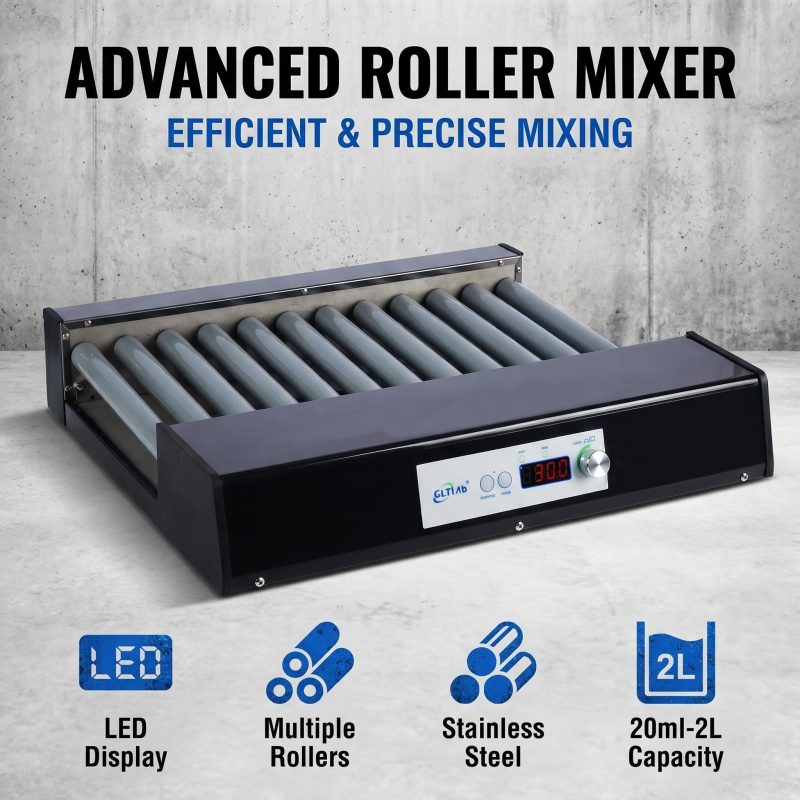
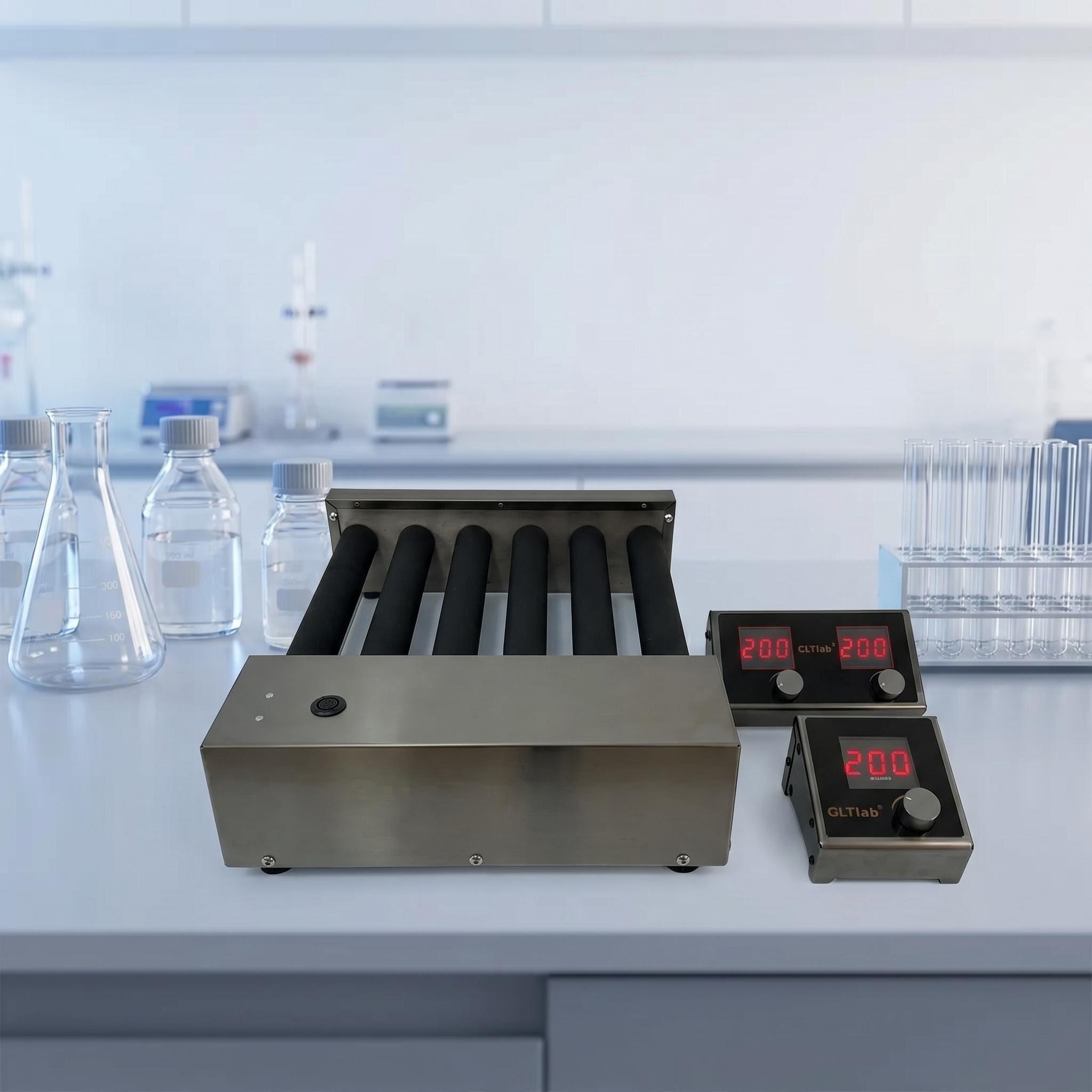
A roller mixer is a gentle mixing device based on the roller transmission principle. Its core structure consists of a group of parallel driving rollers and supporting rollers. During operation, the sealed reaction container filled with resin microsphere suspension and coating solution is placed on the roller group. Driven by the motor, the rollers rotate at a constant and adjustable low speed to drive the container to perform continuous and stable rolling motion.
Unlike traditional stirring equipment that relies on blade rotation to cut and stir materials, the roller mixer realizes the cyclic turnover and uniform mixing of internal materials through the gravity and friction of the rolling container. The whole mixing process is free of blade contact and mechanical shearing. By adjusting the rolling speed, inclination angle and operation time of the rollers, the fluid turbulence degree and material mixing efficiency in the container can be precisely controlled, so as to meet the encapsulation reaction requirements of different resin microspheres and coating materials.
3. Core Functions of Roller Mixers in Resin Microsphere Encapsulation
3.1 Stable Microsphere Suspension to Prevent Sedimentation and Agglomeration
Most resin microspheres have a higher density than the liquid-phase dispersion medium. Under static conditions, microspheres will rapidly settle at the bottom of the container, resulting in uneven contact between microspheres and coating materials, and ultimately leading to incomplete encapsulation and local agglomeration. Traditional low-speed stirring cannot completely eliminate microsphere sedimentation, while high-speed stirring causes secondary damage to particles.
The continuous rolling motion of the roller mixer can maintain a stable suspension state of resin microspheres in the liquid phase for a long time. The gentle cyclic flow of the liquid phase ensures that each microsphere is fully and uniformly dispersed in the reaction system, avoids particle deposition and stacking at the bottom of the container, and provides a uniform reaction environment for the surface coating and grafting reaction of microspheres. This stable suspension effect is particularly critical for long-time encapsulation reactions, effectively improving the consistency of batch products.
3.2 Low-Shear Mixing to Protect Microsphere Structure and Coating Layer
Resin microspheres, especially micron-sized and submicron-sized lightweight microspheres and modified porous microspheres, have fragile structural characteristics. High shear force generated by traditional stirring equipment will not only break complete microspheres into irregular fragments, but also peel off the initially formed thin coating layer on the microsphere surface, resulting in serious product defects.
The roller mixing mode completely avoids mechanical shearing and blade collision. The material mixing relies on natural fluid turnover, which produces almost no destructive force on resin microspheres. It can effectively protect the integrity of the microsphere matrix structure and the stability of the growing coating layer. For multi-layer composite encapsulation and delicate biomaterial coating processes, the low-shear advantage of roller mixers is irreplaceable, which greatly reduces the rate of defective products caused by particle damage and coating peeling.
3.3 Suppress Bubble Generation to Improve Coating Compactness
Bubble defects are one of the main problems affecting the quality of microsphere encapsulation. A large number of tiny bubbles will be mixed into the suspension during high-speed stirring. These bubbles will adhere to the microsphere surface or be wrapped in the coating layer during the encapsulation reaction, forming pinholes and gap defects after curing, which reduce the compactness, flatness and barrier performance of the coating.
The gentle rolling mixing of the roller mixer will not violently stir the liquid phase, and the system maintains a stable laminar flow state, which basically avoids the entrainment of air bubbles. The bubble-free reaction environment ensures that the coating material can be closely and uniformly attached to the microsphere surface, forming a dense, smooth and defect-free encapsulation layer, and significantly improving the overall quality and service performance of resin microspheres.
3.4 Uniform Reaction Environment to Improve Encapsulation Consistency
In the microsphere encapsulation process, the uniform distribution of coating monomers, initiators and modifiers in the system directly determines the uniformity of the coating thickness and surface performance of microspheres. Traditional stirring has the problems of local material concentration difference and dead mixing zones, resulting in inconsistent coating thickness of microspheres in the same batch, and some microspheres even have uncoated blank areas.
The omnidirectional rolling of the roller mixer realizes the overall circulation and uniform diffusion of materials in the container, eliminates the concentration gradient of reactants in the liquid phase, and makes the surface reaction rate and coating growth thickness of each microsphere consistent. This excellent mixing uniformity greatly improves the batch consistency of encapsulated microspheres and meets the high-precision application requirements in the fields of biomedicine and precision composite materials.
4. Process Optimization and Application Advantages
In practical industrial and laboratory production, the encapsulation effect can be further optimized by adjusting the operating parameters of the roller mixer. Low rolling speed (20–100 rpm) is suitable for fragile ultra-fine resin microspheres and thin-layer coating processes to avoid slight particle friction damage; medium and high rolling speed is applicable for thick-layer composite encapsulation and high-viscosity coating systems to improve material mixing efficiency. In addition, the sealed rolling environment of the roller mixer can effectively isolate external dust and impurities, and cooperate with constant temperature control to realize a closed and precise encapsulation reaction, reducing the influence of external environmental factors on product quality.
Compared with traditional mixing equipment, roller mixers have significant comprehensive advantages in resin microsphere encapsulation: lower product defect rate, higher batch consistency, simpler equipment operation and lower maintenance cost. They are suitable for various resin microsphere encapsulation processes such as physical coating, chemical grafting and in-situ polymerization, and have strong process adaptability and application scalability.
5. Conclusion and Outlook
Roller mixers, with their low-shear, low-bubble, stable suspension and uniform mixing characteristics, have become indispensable core equipment in resin microsphere encapsulation technology. They effectively solve the common problems of particle breakage, uneven coating, bubble defects and poor batch consistency in traditional encapsulation processes, and greatly improve the yield and comprehensive performance of encapsulated resin microspheres.
With the continuous upgrading of microsphere precision manufacturing technology, the application requirements for high-uniformity, high-compactness and high-stability encapsulated microspheres are increasingly strict. In the future, intelligent roller mixers with precise speed regulation, constant temperature control and automatic feeding and discharging functions will be further popularized in the field of microsphere preparation, providing more reliable technical support for the high-end application of resin microspheres in new materials, biomedicine and other fields.