
 (+86)0755-21023851
 gque@quixave.com
{“AIGC”: {“Label”: 1, “ContentProducer”: “001191350200737895515300000”, “ProduceID”: “15E1A1E800B041A882A65F8F8A5E3884”, “ReservedCode1”: “uqjy0p6aszui2hsc7zat7xzo2vjmyfq5”, “ContentPropagator”: “001191350200737895515300000”, “PropagateID”: “15E1A1E800B041A882A65F8F8A5E3884”, “ReservedCode2”: “zn730zxq5w0mu0zkaaw30ho6qjp51bjj”}}
In the realm of cell biology and molecular research, maintaining the viability of sensitive samples is paramount. When working within a incubator, the environment is strictly controlled to support cell life. However, introducing mechanical agitation into this delicate ecosystem requires specialized equipment. This is where the CO2 Incubator-Compatible Roller Mixer becomes an indispensable asset.
Unlike standard vortex mixers or high-speed shakers that generate heat and shear forces, a roller mixer designed for environments offers a unique combination of gentle handling and environmental resilience.
️ Why Specialized Equipment is Necessary
Standard laboratory mixers are often designed for benchtop use at room temperature. Placing them inside a humid, -rich incubator (typically at ) can lead to motor failure, corrosion, or, worse, the degradation of your cell cultures due to excess heat generation.
A specialized roller mixer is engineered to overcome these challenges:
- Corrosion Resistance: Constructed with materials that withstand high humidity and atmospheres without degrading.
- Cool Operation: Utilizes brushless DC motors that run cool, ensuring the internal temperature of the incubator remains stable and does not harm the cells.
- Low Profile Design: Optimized to fit within the limited space of an incubator while maximizing sample capacity.
The Mechanics of Gentle Mixing
The core function of this device is to provide homogeneous mixing without damage. It achieves this through a rolling motion rather than vigorous shaking.
- Rolling Action: The rollers rotate the tubes or bottles, causing the liquid inside to flow smoothly. This is crucial for viscous liquids or blood samples where air bubbles must be avoided.
- Rocking Motion (Optional): Some advanced models combine rolling with a gentle rocking (tilting) motion. This ensures that the entire inner surface of the container is wetted, which is ideal for preventing cell sedimentation.
Note: This gentle 3D mixing action is particularly beneficial for blood samples, as it allows for mixing without the need for anticoagulants in certain diagnostic tests, and prevents hemolysis (destruction of red blood cells).
Key Applications
The versatility of the roller mixer makes it a staple in various biological workflows:
- Cell Culture: Keeping suspension cells in suspension without damaging the cell membrane.
- Blood Banking: Gently mixing blood samples to ensure uniformity for testing.
- Molecular Biology: Mixing viscous solutions, such as DNA/RNA extraction buffers, where pipetting might introduce shear stress.
- Immunoassays: Ensuring consistent antigen-antibody reactions during incubation.
️ Technical Considerations for Selection
When selecting a roller mixer for your incubator, consider the following specifications to ensure compatibility and performance:
| Feature | Importance |
| Motor Type | Brushless DC motors are preferred for their longevity and lack of ozone generation. |
| Speed Control | Variable speed allows optimization for different viscosities. |
| Speed Control | Variable speed allows optimization for different viscosities. |
| Material | Stainless steel or chemical-resistant polymers are essential for easy cleaning and sterilization. |
| Power Cord | Flat, thin power cords are often used to fit through incubator door ports without compromising the seal. |
Conclusion
The integration of a CO2 Incubator-Compatible Roller Mixer into your laboratory setup bridges the gap between rigorous mixing requirements and the delicate needs of living cells. By providing a gentle, consistent, and temperature-safe mixing environment, it ensures that your experimental results are driven by biology, not mechanical stress.
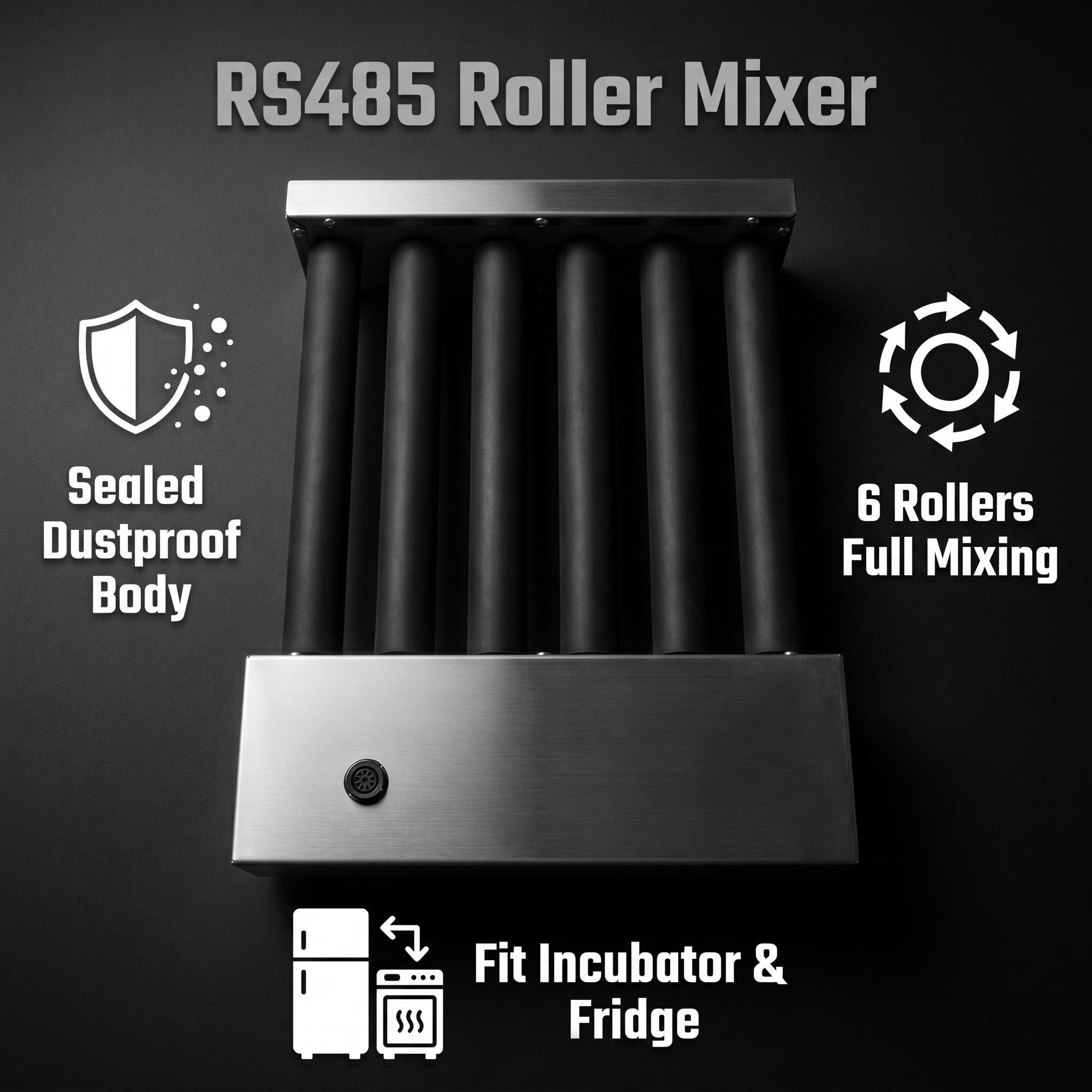
The roller mixer developed by GLTLAB, which supports external control regulation or RS485 control, can meet such experimental requirements. It features a fully enclosed stainless steel body, and the overall structural dimensions can be adjusted according to the limited size of the enclosure. It has a rotating speed range of 1-120 rpm, supports a maximum timing of 200 hours, forward and reverse rotation, and stepless speed regulation, which can fully meet your experimental requirements.