
 (+86)0755-21023851
 gque@quixave.com
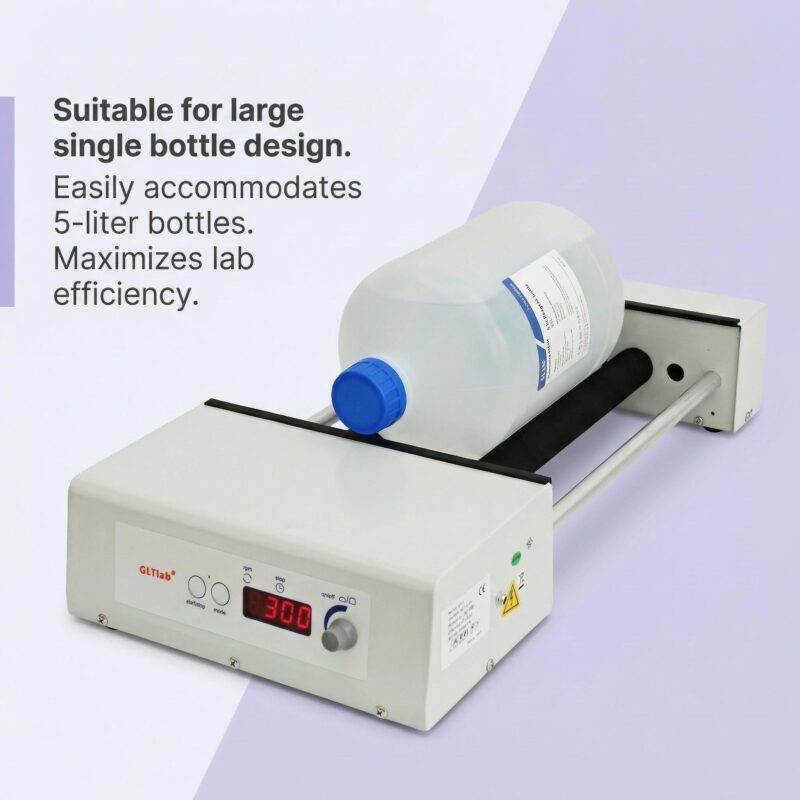
For large roller bottles of 5L and above (typically with a diameter of φ150–250mm and a net weight of 5–15kg per bottle), model selection must comply with five core hard indicators: large roller spacing, high load capacity, robust frame, stable rotational speed, and high safety. Industrial-grade or pilot-scale models shall be prioritized, and conventional small laboratory roller mixers must not be used under any circumstances.
1. First calculate the core dimensions of the roller bottle (determines whether the bottle can be placed stably)
Common specifications for 5L and above roller bottles:
Diameter: φ150–250mm (critical parameter)
Height: 250–400mm
Full weight per bottle (including material solution): 5–15kg
2. Roller system (the core component that directly determines compatibility)
(1) Roller spacing (top priority)
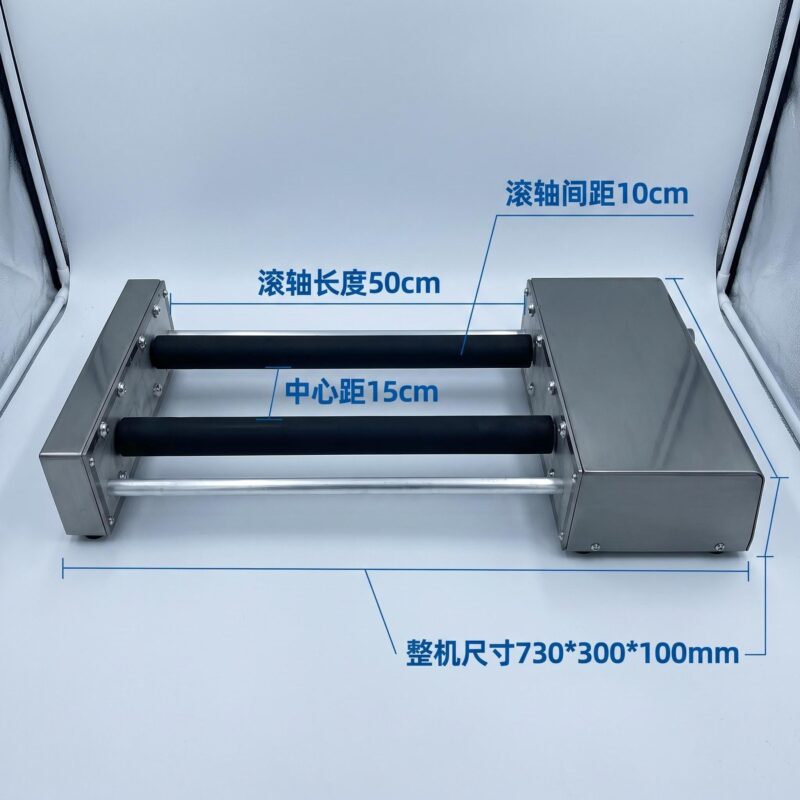
Requirements: Net spacing ≥ 60%–70% of the bottle diameter, and net spacing < bottle diameter (to prevent falling).
For 5L bottles (φ150mm): net spacing of 90–110mm, center distance of approximately 150–180mm.
For 10L bottles (φ200mm): net spacing of 120–140mm, center distance of approximately 200–220mm.
For 20L bottles (φ250mm): net spacing of 150–170mm, center distance of approximately 250–280mm.
Selection requirement: Models with adjustable wide spacing (80–180mm adjustable) or customized fixed spacing must be selected; conventional spacing of 20–50mm is completely unusable.
(2) Quantity, length and diameter of rollers
Quantity: 3–5 rollers (3 rollers are the most stable for 5L and above bottles; 4–5 rollers can hold multiple bottles but require strict equal spacing).
Length: ≥ 400mm (ensures full contact between the bottle body and rollers, avoiding suspension).
Diameter: ≥ 40mm (larger diameter provides higher stability and load capacity; φ40–50mm is recommended, and φ50mm is commonly used for industrial-grade products).
Material: 304/316L stainless steel (mandatory requirement, provides corrosion resistance, heavy load tolerance and easy cleaning; conventional silica gel/rubber coating is prohibited, as it is prone to deformation and falling off).
3. Load capacity (directly related to service life and safety)
Calculation formula: Full weight of single bottle × number of bottles × safety factor of 1.5–2.0 (sufficient margin must be reserved for long-term heavy-load operation).
For two 5L bottles (10kg × 2): minimum load ≥ 30kg.
For two 10L bottles (15kg × 2): minimum load ≥ 45kg.
Selection requirement: Industrial-grade models with a load capacity of 30–50kg shall be selected; conventional laboratory models with a load capacity of 5–10kg are absolutely prohibited, as they will directly bend the rollers and burn out the motor.
4. Drive and control (ensures stable mixing without shaking or vibration)
(1) Rotational speed range and accuracy
For 5L and above roller bottles: low-speed stability is the primary requirement, and 5–100rpm is recommended (20–50rpm is commonly used; excessively high rotational speed easily causes material splashing and instability).
Control requirement: Digital display closed-loop speed regulation (±1rpm), with forward/reverse rotation and intermittent rolling functions (prevents sedimentation and improves mixing uniformity).
Motor requirement: High-power brushless DC motor (provides large torque, low heat generation and long service life; conventional small AC motors are prohibited).
(2) Operation mode and inclination angle
Mode: Pure rolling (the first choice for large roller bottles, providing high stability) or rolling + micro-swing (amplitude ≤ 15mm, assists mixing and must not be too large).
Inclination angle: 0°–5° adjustable (micro-inclination prevents bubble generation and facilitates drainage; large inclination angles are not recommended for 5L and above bottles, as they easily cause rollover).
5. Body and safety (guarantee for long-term use in industrial environments)
Body material: Full 304/316 stainless steel (provides rust resistance, corrosion resistance and easy cleaning; cold-rolled steel with paint coating is prohibited, as paint is prone to falling off and rusting).
Structure: Heavy frame + thickened base plate (prevents vibration and deformation; whole machine weight ≥ 20kg, higher weight provides better stability).
Safety configuration:
Overload/overcurrent/short-circuit protection (prevents motor burnout).
Pinch-proof fully enclosed casing.
Low noise ≤ 60dB (ensures comfortable working environment even in industrial settings).
Power-off memory + long timing (99h) (suitable for long-term incubation/mixing).
6. Scenario-based model selection recommendations (direct matching)
(1) 5L roller bottle (φ150mm, 5–8kg per bottle)
Rollers: 3 rollers, φ40mm, 400mm in length, 100mm net spacing (adjustable 80–120mm).
Load capacity: ≥ 25kg (can hold 2 bottles).
Rotational speed: 5–100rpm, digital display, forward/reverse rotation.
Body: All stainless steel, heavy frame.
(2) 10L roller bottle (φ200mm, 10–12kg per bottle)
Rollers: 3 rollers, φ50mm, 450mm in length, 130mm net spacing (adjustable 100–160mm).
Load capacity: ≥ 40kg (can hold 2 bottles).
Rotational speed: 5–80rpm, digital display, rolling + micro-swing.
Body: All stainless steel, thickened base plate, whole machine weight ≥ 25kg.
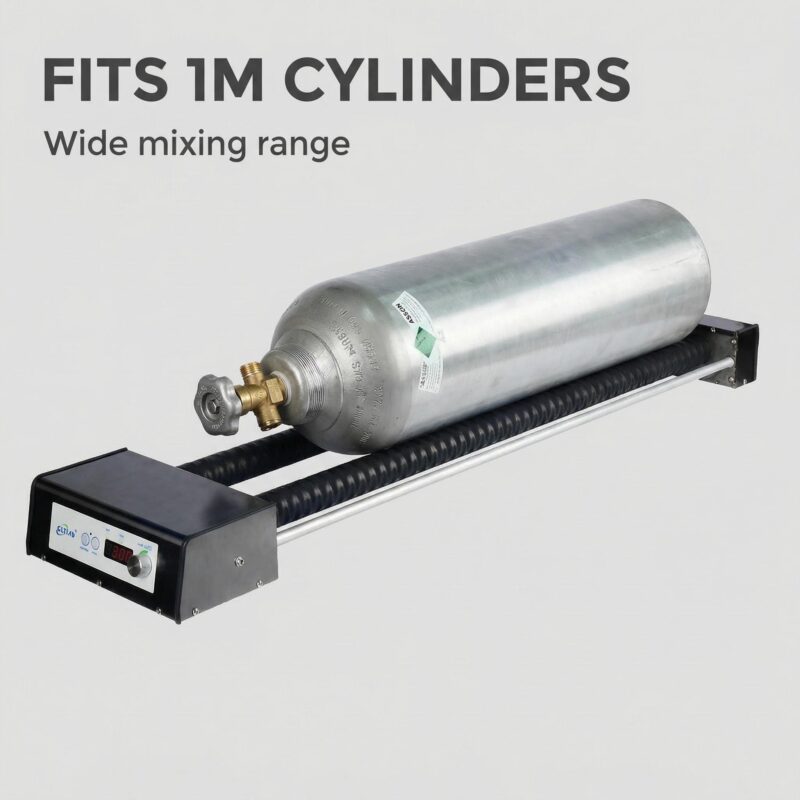
(3) 20L roller bottle (φ250mm, 15kg per bottle)
Rollers: 3 rollers, φ50mm, 500mm in length, 160mm net spacing (adjustable 120–180mm).
Load capacity: ≥ 50kg (for single-bottle use only, multiple bottles are not recommended).
Rotational speed: 5–60rpm, digital display, pure rolling (most stable).
Body: All stainless steel, ultra-heavy frame, whole machine weight ≥ 30kg.
Reference model: Customized industrial-grade 3-roller roller mixer.
7. Taboos for avoiding mistakes (absolutely unacceptable errors)
❌ Placing 5L and above roller bottles on conventional small laboratory roller mixers (load capacity 5–10kg, roller spacing 20–50mm) → will definitely cause equipment damage.
❌ Roller spacing < 50% of bottle diameter → poor rolling performance and high risk of rollover.
❌ Roller diameter < 30mm and length < 300mm → insufficient support and easy deformation.
❌ Unqualified load capacity without safety margin → motor burnout and frame fracture.
❌ Silica/rubber coated rollers → rapid wear under heavy load, falling off causes product contamination.
Summary
Selection formula for 5L+ large roller bottles:
3 to 5 shafts (3 shafts are preferred) + φ40-50 mm stainless steel rollers + 90-170 mm clear spacing (matched with bottle diameter) + load capacity ≥ 30 kg (1.5 to 2 times safety factor) + digital display low-speed (5-100 rpm) + all-stainless steel heavy-duty frame.
Accordingly, the models recommended by GLTLAB for you are TR-1Basic, TR1-500 and TR1-1000. For more parameters, please consult our customer service staff.
{“AIGC”: {“Label”: 1, “ContentProducer”: “001191350200737895515300000”, “ProduceID”: “65A7D8DDDD924EF98EB0D378F4E0BD7A”, “ReservedCode1”: “0eiyha6t4en9xyq4zbmxrrq5br43vby0”, “ContentPropagator”: “001191350200737895515300000”, “PropagateID”: “65A7D8DDDD924EF98EB0D378F4E0BD7A”, “ReservedCode2”: “kq48hiww2hh02gtr0c0eed1jw1neog8u”}}
{“AIGC”: {“Label”: 1, “ContentProducer”: “001191350200737895515300000”, “ProduceID”: “3869869C69C54419AE593F47DF008945”, “ReservedCode1”: “xn4epgki6dwixut4w5zq7zhzc1hbz4m8”, “ContentPropagator”: “001191350200737895515300000”, “PropagateID”: “3869869C69C54419AE593F47DF008945”, “ReservedCode2”: “vxd2y0k6uctzfzyopcepv2arhapv04ny”}}
{“AIGC”: {“Label”: 1, “ContentProducer”: “001191350200737895515300000”, “ProduceID”: “B9747B06E1F643B0B9219727AB6F6971”, “ReservedCode1”: “anoh1lxuf9s3i70y99t6rouv69m1m3x1”, “ContentPropagator”: “001191350200737895515300000”, “PropagateID”: “B9747B06E1F643B0B9219727AB6F6971”, “ReservedCode2”: “mv18hcwpvxskrimvhamjc4ugrygb6plj”}}