
 (+86)0755-21023851
 gque@quixave.com
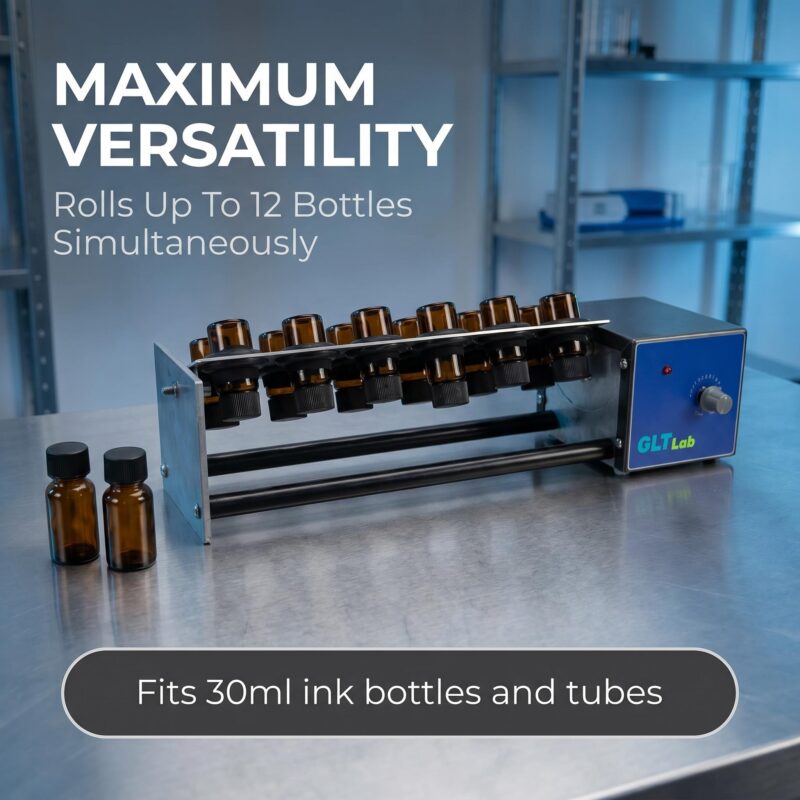
The specific application of long-axis rotary mixers in pigment shaking (such as tattoo inks or art paints) mainly relies on their unique rotary mixing mechanism. Here are the specific application scenarios, advantages, and operational recommendations for pigment processing:
1. Core Application Scenarios
- Preventing Pigment Sedimentation and Separation: Heavy pigment particles in inks tend to settle at the bottom when left standing. The 360° tumbling or rolling action of the long-axis rotary mixer effectively breaks up the layers, allowing the settled pigment and carrier liquid to blend back into a uniform mixture.
- Pre-treatment of Large Batches of Ink: Compared to manual shaking, a long-axis rotary mixer can process multiple containers of different specifications simultaneously (such as 1.5ml, 15ml, 50ml centrifuge tubes, or ink bottles). This makes it ideal for large-scale ink preparation before tattoo sessions or art creation.
- Gentle Mixing to Prevent Damage: Pigments (especially those containing special microparticles or high-viscosity inks) can generate a lot of air bubbles under vigorous shaking, which affects the coloring process. Since long-axis rotary mixers typically operate at low speeds (e.g., 20-80 rpm), they provide gentle mixing that ensures thorough blending while effectively preventing air entrapment and bubble formation.
2. Advantages Over Traditional Manual Shaking
- Eliminating Safety Risks: Vigorously shaking sealed ink cans causes internal pressure to build up. This not only leads to foaming and expansion but can also cause the container to rupture and spray ink, resulting in waste and safety hazards.
- Avoiding “Dead Zones”: Manual shaking often fails to fully suspend the pigment at the bottom. In contrast, the rolling and tumbling action of the rotary mixer covers the entire interior of the container, ensuring a thorough mix with no dead zones.
- Standardization and Consistency: The constant speed and timing settings of the machine ensure that the texture, color, and flowability of the mixed ink remain highly consistent. This is crucial for tattooing or painting tasks that require precise color matching.
3. Recommended Operating Parameters
- Speed Settings: For ink shaking, it is recommended to use low-to-medium speeds (typically between 20-80 rpm). This gentle rolling process ensures the pigment remains fully suspended without compromising the physical structure of the ink.
- Operating Modes: For inks with severe sedimentation, a continuous mode can be used for several minutes until no lumps are visible at the bottom and the color is uniform. For routine, mild anti-sedimentation, a timed mode can be set for short-duration mixing.
4. Precautions
- After mixing, it is recommended to dip a stirring rod or dropper into the ink to check its texture. Ensure it is smooth, lump-free, and uniform in color before use.
- If the ink is highly viscous or severely settled, rotary mixing alone may not be sufficient. In some industrial or professional settings, ultrasonic dispersers are used in combination to further reduce pigment particle size, improving the ink’s smoothness and skin penetration.
{“AIGC”:{“Label”:1,”ContentProducer”:”001191350200737895515300000″,”ProduceID”:”e9683972-671e-423a-b500-b7ceee0be2f5″,”ReservedCode1″:”13372bc0-d3a1-4127-9e90-34f5eaed03ba”,”ContentPropagator”:”001191350200737895515300000″,”PropagateID”:”e9683972-671e-423a-b500-b7ceee0be2f5″,”ReservedCode2″:”6a3decc8-45b5-4ccf-994e-87394e995ff7″}}